

PAST AS FUTURE
THEN
VINE DELORIA
I know a lot of Indian stories about places in America. St. Anthony Falls was once a holy shrine of the Sioux Indians. You go there, and you’re filled with wonderment: what did it look like when we had it? What did it really look like before television and fast cars and jet airplanes?
None of these tribes saw enough whites at any one time to ever regard them as dangerous. If you have a tribe of five hundred sitting on a hillside and a wagon train of two hundred people goes by, that’s no threat to you. You hear a lot of stories, traditional ones, that the Indians were afraid of the whites because they thought they were crazy. You read the tremendous sacrifices the pioneers made to get across the great plains. You think of your own people who sat on the hillside, who knew every creek and rock for a thousand miles around. They’re looking down at these people, who are terrified because they’re in tall grass. Neither side understands the other. Perhaps the Donner party might have been saved had they been friends of the Indians, had they not been frightened of these “enemies” who knew the terrain. You have to take a new look at what you thought America was before you can figure out where it’s going.
I went to grade school, half white and half mixed-blood Indians. They taught us Rudyard Kipling’s world view. It was a simplistic theory that societies marched towards industry and that science was doing good for us. We’re all Americans and none of us is ever disloyal. The United States has never been on the wrong side of anything. The government has never lied to the people. The FBI is there to help you, and if you see anything suspicious, call them. There was a heavy overtone of the old British colonial attitude. Nothing about the slaves. Minority history just didn’t exist. The world somehow is the garden of the white people, and everybody else kind of fits in someplace.
My family had been religious leaders before they’d become Christians. The old Indian religion. I was not just a minister’s son. Mine was a long family history of medicine men. People came to my father for all sorts of things. He knew all kinds of medicine songs and stories.
The young Indian as well as the young white has no sense of history whatsoever. I think the Second World War did it. History, for a long time, was dominated by Europe. The United States came out of World War II as the great power. All of a sudden, we had responsibility. Our history has always been parochial. We were separated by oceans, we didn’t know where we were. The anti-communist paranoia took over: nobody’s ever gonna conquer this country, by God. If we’re destroyed, it will be self-destruction.
Maybe the American Dream is in the past, understanding who you are instead of looking to the future: What are you going to be? ‘Cause we’ve kind of reached the future. I’m not just talking about nostalgia. I’m talking about finding familiar guideposts. Maybe this is a period of reflection.


Vine Deloria was a Native American Activist and Author pictured above is the cover of his 1995 book "Red Earth, White Lies".
NOW
ANDY PARSLEY
A lot of my growing up took place in the eighties, and it was Cold War time…I do remember having a social studies class where we had a speaker come in and talk to us about a variety of topics and then gave us a quiz and one of the questions was “Capitalism is better than Communism, true or false?” And the correct answer was true! And I thought that was rather one-sided. I agree, but it wasn’t a very open minded way of asking the question.
The way history was taught to me growing up was the history of white people, especially the history of white men. Every other group was taught in relation to white men. So we learned very little about African-Americans, or people who came from anywhere besides the white parts of Europe. Slavery we learned about from the perspective of white people…That was the sense of history, even when I went off to college. The idea that anyone else had contributed to history, the history of our nation…if they had I didn’t know much about it, it certainly hadn’t been taught to me.
Your understanding of history is going to shape the way you view modern times, so it’s imperative that all Americans have a very well-rounded understanding of history, and that it’s as inclusive as possible, and that we don’t shy away from the ugly moments of American history, but also the incredible moments of American history. If you look at what’s going on in the United States today you will see there are amazing, wonderful, beautiful things happening…there’s also things that we should not be proud of as Americans that are happening today, but that’s how it’s always been, and how it always will be, and if you have any sort of overly romanticized view of American history or also any view of American history where you view it as too negative as some point in the past, because there’s always been people who were out to do go, out to make this country and this world a better place.
I was definitely taught a simplified version of how we should view the government, which was much more trusting. And it’s also the official version, this is the branch that makes the laws, this is the branch that enforces the laws, this is the branch that interprets the laws, things like that. But of course when you look at all these things in greater depth you see the impact of money, politics, greed, corruption, and a lot of times you see the wisdom of the founding fathers, in setting up a system of checks and balances.
I don’t think a teacher’s job should be to teach people that you should implicitly trust the government because they’re the government, they’re the official power. I think that that is a horrible message, the last thing that we should do, because there’s no evidence, really, to back up that that’s reality.
I think that your generation has a more nuanced version of the American dream than any generation we’ve had in long time. You don’t seem like you’re buying into things as much as previous generations, in a way that might sound like you’re jaded, but that interacting with people of your generation hasn’t really made me think that; I think that you’re better consumers of knowledge, and of information, so when you think about how you want to invest your time, your life, your effort, you’re not as interested in materialism or in things like blindly achieving material success or career success at a prestigious job, but in my experience your generation has shown a lot of interest in making the world a better place, and doing things that aren’t going to be harmful to the environment, or to underprivileged people, and in living in a way that’s harmonious with your values.
I don’t think there’s a monolithic American dream right now. I think it means vastly different things to different people. And I would say that you’re asking me this question today, on Super Tuesday, really illustrates that point. When a large number of Americans voted for Donald Trump today, after he’s made disparaging comments, and comments that are unkind towards lots of different groups of people, lots of minority groups, women, and that he is seen as somebody that we would elect as president that tells me a lot about the American dream of some Americans. We have a lot of other Americans who are backing someone like Bernie Sanders, who probably doesn’t have much chance to win this election, but people see his ideals of valuing equality, equal opportunity, as something that we should aspire to as a nation. That’s very telling in terms of how we as America view the American dream, that it’s not one thing anymore.
Click below to hear a snippet of Andy's interview.
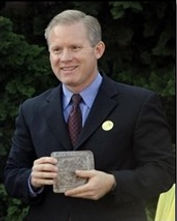
Andy Parsley with a potholder.
