

THE PACIFIC
THEN
ROBERT LEKACHMAN
I found myself ghostwriting. The company commander was supposed to write a personal letter of condolence to the parents or wife or next of kin. He’d give me a name of a young kid, particularly in Okinawa, who came up to the line and got killed the next day. What was there personal that could be said? What could I say that would console the family? So it was a case of creative fiction. I also became something of an expert in writing citations for medals. This was really creative fiction. There was an awful lot of hustling for awards. Each one was worth five points. People were shipped back home in the order of points accumulated. But there were so many acts of genuine bravery too.
In the Pacific, there were none of the European diversions. What you tended to see was miserable natives and piles of dead Japanese and dead Americans. I was not a virulent hater of the Japanese. I didn’t collect ears, as I knew some others did. We had been fed tales of these yellow thugs, subhumans, with teeth that resembled fangs. If a hundred thousand Japs were killed, so much the better. I wasn’t innocent, either. You couldn’t escape it. When I heard about Hiroshima, I felt great: we won’t have to invade Japan.
Towards the end of Okinawa, people who had been in all three campaigns were really zonked out. There was a rash of guys shooting themselves in the foot, anything to get hospitalized. One guy deliberated scratched a jungle-rot infection until it got so bad he had to be sent back to Hawaii. But I heard of no fragging of unpopular officers, as in Vietnam.
Unlike Vietnam, it wasn’t just working-class kids doing the fighting. You go to college faculty clubs today and on the walls are long lists of graduates who died in the Second World War. It was the last time that most Americans thought they were innocent and good, without qualifications.
There were black marketeers on the home front, people who were, as usual, looking out for themselves. But most Americans at home did observe price controls and rationing. Soldiers who came home on leave were treated with respect by the folks, unlike the Vietnam veterans. They bought war bonds: Buy yourself a tank. It was an idealistic war. People still believed.
NOW
STEPHEN KENT


Pictured above are two Marines at the Battle of Okinawa, May 18, 1945
I’ve never liked war movies, I’m not sure why. To me they are not very interesting, but my father fought in World War II, so I know things that he told me. And all of it seemed very far away and removed by time, so it didn’t have much direct impact on me. The stories I thought were kind of interesting, because what he did was very different from what I knew that he did every day. He was a radar officer on a bomber, so he got to tell the people when to drop the bombs on the Japanese. That was just weird because it is not like anything I would know about him or think about him. But he also told this story about the only living thing that he actually killed himself was a goat. He was on guard duty at night on one of the islands and he heard a sound, and he said what he was supposed to say and he got no answer, so he shot and in the morning it was a dead goat.
I don’t think war is ever worth it but I think it was an inescapable war. If America hadn’t gotten into the war then we’d all be members of the Nazi party, if we survived. So, yeah, never worth it. But necessary.
Do you think it is honorable to be a soldier?
I think it is honorable to be a soldier. But on some level I do equate war to murder. When you kill someone it’s murder and it doesn’t matter if it’s for a good cause or not, it’s murder. Now, is it a crime? That might be a better question, but I don’t know. I think not, but I’ve never had to do that, or think about it personally.
I had plans if I lived through the period of the Vietnam War. I avoided being drafted because it was a draft lottery and I had a high number. But if I was called to be drafted, I would go to Canada. When they instituted the draft lottery, I was in college. Not a lot of people liked the Vietnam War. And do you know what? I don’t think I ever talked to my parents about it. But most of the people I knew were against it, you know, I was in college, there were all of the protests.
The thing about the lottery is that they did it on TV. I was in a dorm and we all gathered in the TV room and they called–it was by birth date. They would just pull out birth dates and that would be it. And you watched people just sink. Because they knew if they had a low number they would be called up soon. I’d have to wait a long time before they called my name.
I was a kid when the Korean War was going on, and I don’t remember hearing much about it. And that’s kind of weird to me. At one point we had a next door neighbor, a guy who was either eighteen, nineteen, twenty, twenty-one, who went to the Korean War. It’s really abstract to me. But no one was really talking about it.
World War II I learned about through reading, mostly historical fiction, and movies. Not the war movies, but the movies that happened to take place during the war. But scenes of battle never interested me.
Would you consider yourself a pacifist?
No, a coward. [Laughs.] I think there are all kinds of ways to justify all kinds of things, but I don’t know what a pacifist is. You don’t know until you’re forced to do something about it and I was never forced to do anything, to make a stand. I mean, I had plans, but who knows if I would’ve carried them out. So, I don’t know.
Do you trust the government?
No. I would like to, there are people in government that I trust, but no, I don’t. I think there are lots of good intentions, but there’s just a lot of power-grabbing. It’s really hard to do good work when what you’re interested in is power. I think that, unfortunately, a lot of the people that go into government are interested in power and not really interested in helping people.
Do you think your government has actively deceived you?
I’m sure it has. I think it should. In some cases, the government should deceive people. I wouldn’t say lie to me, but keep information. It’s really hard just to trust things blindly. When you’re younger you can do that. But I do believe there’s more good than bad, more positive than negative. Much more.
Click below to hear a snippet of Stephen's interview.
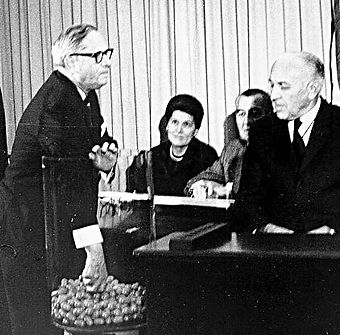
Above, Representitive Alexander Pirnie draws a number during the war draft lottery drawing on December 1, 1969. Photo by the U.S. Selective Service System
